
Powell writes to Vought in defense of Fed renovation projects
Federal Reserve Chair Jerome Powell wrote to OMB Director Vought on Thursday in response to accusations of "serious mismanagement" in the renovation of Federal Reserve buildings. Powell stated that the projects involve two historic buildings from the 1930s that have never undergone comprehensive renovation. Meanwhile, White House officials have used the project as a focal point to question Powell's suitability for his role, while potential successor Kevin Warsh has called for a "regime change" at the Fed.
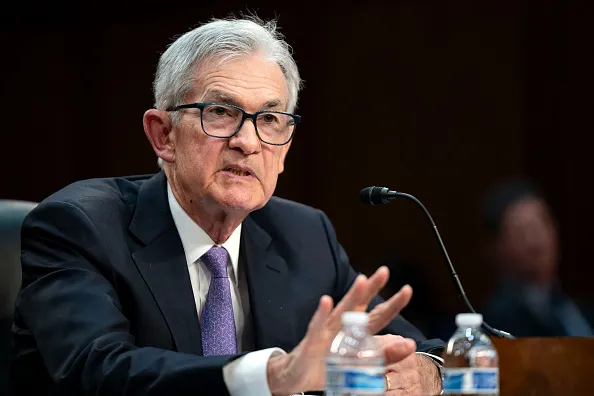
Federal Reserve Chairman Jerome Powell responded in a personal letter on Thursday to Office of Management and Budget Director Russ Vought. Vought last week accused the central bank chief of "gross mismanagement," specifically citing two unfinished Federal Reserve office renovation projects in Washington, D.C., which have exceeded their budget.
"The project is large because it involves the renovation of two historic buildings from the 1930s on the National Mall," Powell wrote in Thursday's letter. "Although regular maintenance has been performed to keep the buildings usable, neither building has undergone a full renovation since they were built."
Much of Powell's letter reiterated points from a document the Fed posted on its website on July 11 under its "Frequently Asked Questions" section.
But some members of the Trump administration have begun using the $2.5 billion renovation project as a proxy issue for Powell's fitness for office—specifically, his resistance to the president's pressure to lower interest rates.
Vought called the renovation, originally estimated to cost $1.9 billion, an "outrageous cost overrun" at a breakfast briefing on Thursday. According to the Financial Times, Vought said Trump "is a builder" and, given his real estate developer background, was "shocked" by the scale of the renovation.
Last month, Powell dismissed reports that the project included a VIP restaurant, dedicated elevators, and ornate water features in response to questions from six Republican senators, bringing the renovation into the public eye.
The Fed clarified in its FAQ document the use of marble in the project and responded to the proposed "terrace garden," saying it would serve as a "green roof" for stormwater management and improved building energy efficiency. Powell reiterated these points on Thursday.
However, Vought said at a briefing earlier that day that the Fed had either "misled Congress or needs to go back to the National Capital Planning Commission to have the project reassessed."
Powell said Thursday that the Federal Reserve Board "is generally not subject to NCPC jurisdiction in its building projects," but noted that it "voluntarily cooperated" with the commission "in the early stages of the project" and "benefited from broad and collaborative communication."
Powell added that the Fed's inspector general has "full access" to the project's cost, contract, schedule, and expenditure information and receives monthly updates. "I have also asked the inspector general to conduct a new review of the project," Powell said Thursday.
Vought said Thursday that this was "not enough" and that OMB officials wanted to visit the Fed construction site "within the next week or so." "We want to sit down with the people responsible for the project, hear their briefing, and understand how the project is progressing," Vought said.
However, Vought cautioned reporters to view his argument from a micro perspective. "(This) is not a metaphysical debate about the Fed and its independence," he said. "It's just a building that was poorly managed, leading to massive cost overruns."
"Regime change"
As for the Fed and its leaders reporting to Congress on the project, Florida Republican Representative Anna Paulina Luna posted on X on Thursday that she was "making a criminal referral of Jerome Powell (to the Department of Justice) to investigate his perjury regarding the insane $2.5 billion building."
Powell's and Vought's remarks came a day after reports that Trump had floated—and then backed away from—the idea of firing the Fed chairman.
In another development Thursday, Kevin Warsh, the leading candidate expected to succeed Powell, advocated for a "regime change" in the central bank's policy implementation.
Warsh said on CNBC that the Fed should coordinate with the Treasury on managing U.S. Treasury issuance. Trump wants lower interest rates to reduce the cost of financing debt. However, the Fed is shrinking its balance sheet by allowing proceeds from maturing debt to not be reinvested.
"I think the Fed's balance sheet size is wrong," Warsh told CNBC. "Cutting interest rates is the beginning of getting the balance sheet size right."
Warsh called Thursday for a "new Treasury-Fed agreement, like in 1951, when we again accumulated national debt and the central bank was at odds with Treasury goals." "If we reach a new agreement, then... the Fed chair and Treasury secretary can clearly and prudently describe to the market: 'This is our target for the Fed's balance sheet size.'"
Whether coincidental or not, the Fed-Treasury alignment aligns with the ideas of far-right theorist Curtis Yarvin, whose views have influenced several figures in the Trump administration—especially Vice President JD Vance.
"My bold plan is to merge the Fed and Treasury and revalue assets," Yarvin told a Financial Times columnist. "It is very wrong to treat Treasury debt as debt—they are restricted stock."
Warsh, for his part, said "there needs to be an exit plan for the Fed to get out of the fiscal business and hand power back to Secretary Bessent."
Despite the above push, Warsh still said "independent operations in monetary policy implementation are crucial... but that does not mean the Fed is independent in everything it does." "In my view, the credibility deficit lies with the current Fed officials," Warsh told CNBC.
One of those current officials, Fed Governor Christopher Waller, said inflation was at least partly responsible for the inflated renovation costs. "This is common in any construction project I've heard of—I'm not defending it—but it's not unusual," he said. "Inflation was much higher than anyone expected when bidding took place in 2017. So, that's clearly a factor."