
Furniture Retailers Navigate Supply Chain Turmoil: From Shipping Delays to Nearshoring
Over the past year, supply chain issues such as port congestion and container shortages have forced some retailers to turn to air freight, but furniture, due to its large size, heavy weight, and concentrated manufacturing, is difficult to adopt this approach. Industry executives and consulting experts point out that unpredictable ocean shipping and port congestion remain the biggest pain points, and companies are responding by increasing inventory, changing entry ports, and expanding sourcing and production bases in Vietnam, India, Turkey, and Mexico.
Last year, amid port congestion, container shortages, and other supply chain woes, retailers and brands turned to air freight, pushing 2021 air cargo demand up nearly 7% compared to 2019 (according to IATA estimates). Flying shirts, shoes, or Beanie Babies has been an expensive but viable workaround for many businesses facing shipping bottlenecks. However, flying sofas or dining tables is far from that.
Furniture and other home goods are bulkier, heavier, harder to handle, more complex in craftsmanship, and often geographically concentrated in manufacturing, facing a unique set of supply chain challenges even in normal times. The pandemic amplified all these issues and created new ones.
Pressure and backlogs move through the supply chain along with the goods. "First the manufacturers, then the raw materials—fabric, springs, and leather; then the Asian ports, then the U.S. ports," Overstock.com CEO Jonathan Johnson said in an interview. The industry is still digesting backlogs and delays, but retailers have partially adapted by accepting uncertainty and viewing shipping delays as the norm at this stage.
"This inconsistency has almost become normalized, which means everyone has to build more time into the supply chain," Rick Jordon, senior managing director at FTI Consulting, said in an interview. Williams-Sonoma Inc. CEO Laura Alber echoed similar sentiments to analysts in March: "Our view is that this year will be roughly the same as last year, and we thought it couldn't get worse than last year."
A 'Perfect Storm'
Jordon said the biggest challenge in the current furniture supply chain is the unpredictability of ocean shipping and port congestion. "This has been the biggest pain point for some time," Jordon said. "A 20-day voyage can turn into 65 days, then shorten to 35 days, and then go back to 80 days."
Andrew Csicsila, managing director of AlixPartners' consumer products practice, noted that last year saw a surge in demand for home goods—as consumers redecorated—while container shortages and "chokehold" congestion at Asian and subsequently U.S. ports caused widespread delays.
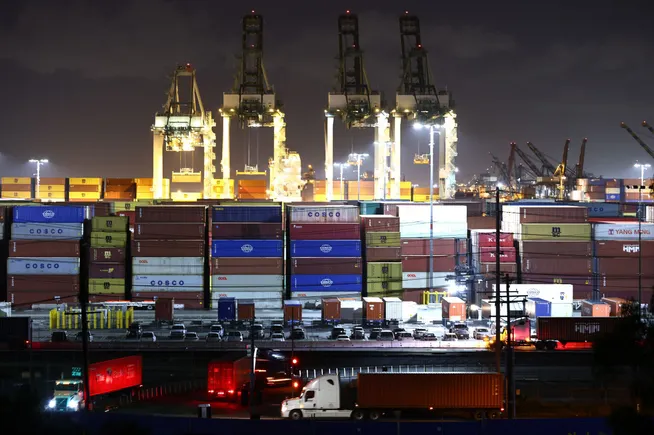
"When the Port of Los Angeles-Long Beach looks like the 405 freeway, with congestion stretching out to sea, 'six weeks to home' no longer exists."
—Jonathan Johnson, CEO of Overstock.com
Soaring commodity prices for furniture raw materials like oil and lumber, coupled with rising freight costs, added financial pressure. La-Z-Boy CEO Melinda Whittington told analysts that shortages of components like microchips and actuators disrupted manufacturing operations for the company's premium products.
Shipping delays obviously also mean delayed customer deliveries, and as systemic backlogs persist, furniture lead times have lengthened. Csicsila said, "People say it's a perfect storm. Supply chain executives are under immense pressure from CEOs to improve service levels." He noted that expected delays have stretched from weeks to within three months, then to three to six months, and even longer. "Now it's: 'We hope it arrives within six months.' Retailers are being more candid. They're trying to figure out where products actually are in the supply chain, but pinning down delivery dates is very difficult."
This is where supply chain management and customer relationship management deeply intertwine.
Johnson said that during the pandemic, Overstock maintained a policy for most items: not selling anything that was "on the water." This meant that 99% of items on its website were stored in domestic U.S. warehouses, ready to be picked, packed, and shipped to customers' homes within days. The online home goods site relies on a drop-ship model, with about 3,500 suppliers serving customers.
"Many companies historically could say: 'Once the goods are on the ship, we know they'll be at your door within six weeks,'" Johnson said. "But when the Port of Los Angeles-Long Beach looks like the 405 freeway, with congestion stretching out to sea, 'six weeks to home' no longer exists."
Despite industry challenges, many large furniture retailers are currently in fairly healthy financial shape. Data provided to Retail Dive by RapidRatings shows that the analytics firm's near-term financial health scores for a group of category participants have improved. Among these companies—Williams-Sonoma Inc., Ethan Allen, RH, La-Z-Boy, Overstock, Basset Furniture, and Wayfair—all except Wayfair saw their financial health ratings improve over the past 12 months, with Wayfair's score dropping 25 points on a 100-point scale. Excluding Wayfair, these companies also scored strong to very strong on core mid-term health metrics.
'We Hope It Arrives Within Six Months'
Unlike retailers of apparel and other softline and small hardline goods, most furniture retailers arguably do not have the advantage of "leapfrogging" across oceans via air freight. Earnings calls and filings from publicly traded furniture giants like Williams-Sonoma, Wayfair, and La-Z-Boy make no mention of air freight in their most recent 10-K reports and calls.
"That's the challenge with furniture, right?" Jordon said of the lack of transportation options.
So waiting, planning ahead, and adjusting sourcing have become the primary tools for furniture sellers. Beyond incorporating lead times into expectations, retailers are also hedging against disruptions by building up inventory. "You'll see it in other areas, like warehousing costs, or how quickly new warehousing facilities are absorbed by the market," Jordon said. "Warehouse utilization is at historic highs right now."
Csicsila noted that building inventory has been key to meeting consumer (and CEO) demands on supply chains. "Many companies are building inventory, ordering more than actual demand, so they have stock to offset service delays," he said.
At La-Z-Boy, Whittington told analysts the company is focused on "protective inventory builds" and has spent $83 million to raise inventory levels to address supply chain challenges. RH spent $191 million in the fourth quarter to increase inventory, with $60 million specifically earmarked for longer transit times and vessel backlogs, CEO Gary Friedman told analysts in March.
Csicsila pointed out that companies eventually have to digest this inventory. Inventory build-ups combined with slowing demand could lead to painful (for retailers) discounting in the future. But the chase for inventory continues. Williams-Sonoma CFO Julie Whalen told analysts that the company's on-hand inventory was up nearly 15% year-over-year, but down 13% on a two-year basis.
Although most furniture still moves by sea, companies in the industry have been changing their entry ports to avoid severely congested ones like Los Angeles and Long Beach. Johnson said that with the West Coast becoming an unsustainable destination, some of Overstock's suppliers are "mid-transit" adjusting their entry points.
Looking Beyond China, Now There's Vietnam
Sourcing often begins near the supply of lumber and other raw materials. Depending on the product, shifting between manufacturers and geographic regions is again more difficult for the furniture category than for peers like apparel retail.
"Furniture tends to consume a lot of wood, so you need to be close to the source of raw materials," Jordon said.
Vietnam has emerged as a major exporting country alongside China. For Vietnam, furniture is the country's number one export product. Csicsila noted that Vietnam has an abundance of skilled labor—crucial for a furniture category that relies on more craftsmanship—and a "willingness to negotiate with retailers to attract business."
Last year, COVID outbreaks in Vietnam and China created massive bottlenecks in the furniture supply chain. "Many of our suppliers were diversifying away from China due to the Trump administration's tariffs," Johnson said. "So there was a massive shift to Vietnam, which helped during China's initial outbreak. But when Omicron hit, Vietnam was hit particularly hard."
Beyond epidemiological factors, industry differences may also have played a role. "Vietnam was hit differently and more severely by the pandemic," Jordon said. "Vietnam doesn't have the infrastructure that China has. There's a lot of investment, but the infrastructure is still somewhat fragmented. So you can have very good manufacturing capabilities, but getting to the port becomes a problem."
Johnson said many of Overstock's suppliers sought new manufacturing partnerships outside Asia during the supply chain crisis, such as in India and Turkey. Shifting furniture production can be more time-consuming and complex than for other goods, but these partnerships are now in place to weather future market fluctuations.
"Having multiple partnerships in multiple countries makes it easier for them to respond," Johnson said. "It's not like flipping a switch, but more like turning on a faucet, going from one to another."
Some retailers and brands have considered or are moving more manufacturing closer to the U.S. La-Z-Boy's Whittington said the furniture brand added three new plants in Mexico over the past year to expand capacity. Discussing the expansion with analysts shortly after some plants opened in June last year, Whittington noted that La-Z-Boy's backlog at the time was about eight times pre-pandemic levels, 16 times higher than at the end of fiscal 2020.
Nearshoring is an obvious way to reduce shipping risks and can improve quality control compared to working with distant manufacturers and factories. Csicsila said Mexico and other Latin American countries, as well as Israel, are vying for more furniture manufacturing business. Some companies are also considering the U.S.—which once had a strong furniture manufacturing industry.
But as Csicsila explained, retailers must weigh whether the reliability gains from nearshoring outweigh the higher wages and other costs of manufacturing outside Asia. Customers are also doing their own calculations on furniture purchases—weighing demand, desire, and price. Csicsila noted that for retailers unable or unwilling to raise prices, even freight savings may not offset increased labor costs.
But in other cases, the added labor costs may be worth it, especially when it creates a lasting competitive advantage. "Word travels fast," Csicsila said. "Having product in the showroom is key. The last thing you want to do is tell a customer an item is out of stock."
